Define behaviour, not appearance alone
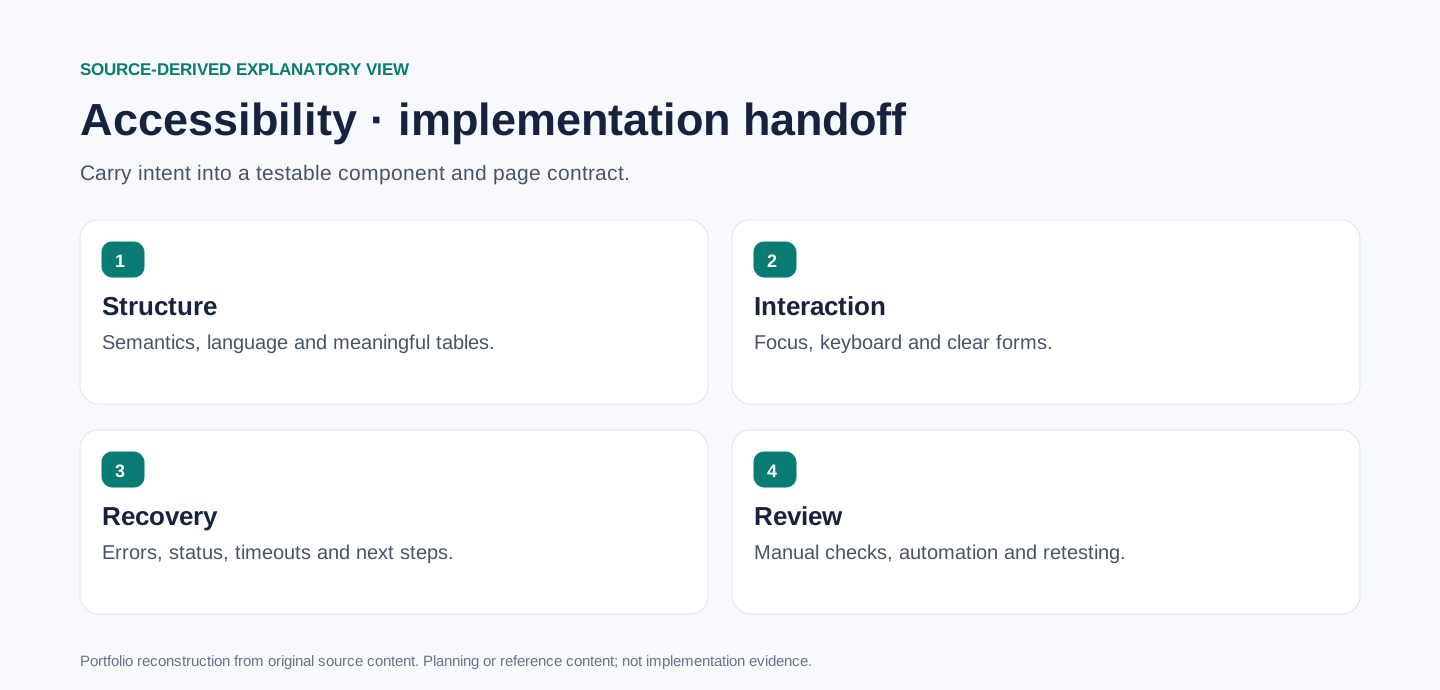
The nineteen-page source reference connects page and component implementation to accessibility review. It covers structure, language, typography/resize, reduced motion, tables, focus, navigation, forms and feedback.
The portfolio explains the intended guidance. Illustrative source snippets are not copied as production code; inspected examples require technical review before reuse.
Describe the component contract
A component needs a meaningful structure, an operable input path and understandable feedback. A form needs a clear label, validation, error recovery and a preserved route forward.
| Implementation area | Handoff expectation |
|---|---|
| Page structure and language | Meaningful semantics and an explicit language context. |
| Navigation and focus | Understandable keyboard movement and visible focus. |
| Forms and errors | Labels, validation and recoverable feedback. |
| Status and timeout | Perceivable updates and an understandable next action. |
| Resize and reduced motion | Respect user needs when size or motion preference changes. |
| Documents and tables | Provide meaningful structure and accessible alternatives. |
Use a testable review record
The guide’s review prompts include keyboard, screen-reader, zoom and automated checks. These methods complement each other and should be linked to a specific page, state and task.
A handoff record should distinguish an implementation issue, its remedy and the evidence from a repeat check. Documentation alone cannot establish conformance.
Maintain a reviewed reference
Before reuse, the guide needs an authoritative version, corrected examples and standards review. Developer acceptance, training and implemented components provide evidence of adoption.
The artifact demonstrates a developer-facing reference scope; it does not establish a certified site or a complete remediation programme.
Document the component behaviour that QA will test
The developer reference includes semantic structure, language, forms, navigation, dialogs, tabs, status updates and input methods. The examples make implementation behaviour visible alongside the design intent.
Keyboard testing and Arabic/English screen-reader checks sit alongside automated checks. The reference is a working guide, so examples and standards need technical review as the product evolves.
Outcomes and learning
A reusable documented reference. Operational adoption and measured effects require separate execution evidence.
About the evidence
- Original developer guide and matching Portal Unification typography, motion, semantics, table, focus, error and status frames.
- Source snippets are illustrative and were not shipped as implementation code.
- Original project materials supplied in October 2026. Excerpts are integrated into the project story; targets and concepts are distinguished from released outcomes.