A service list is not an owner journey
A building owner depends on consultants, contractors and multiple service steps. If stage, responsibility and return reasons are unclear, an available digital service can still leave the owner passive or dependent on support.
The original UX audit identifies siloed services, technical language, weak status/draft continuity and project-ID-led navigation. It explicitly could not complete the full journey or a complete business study.
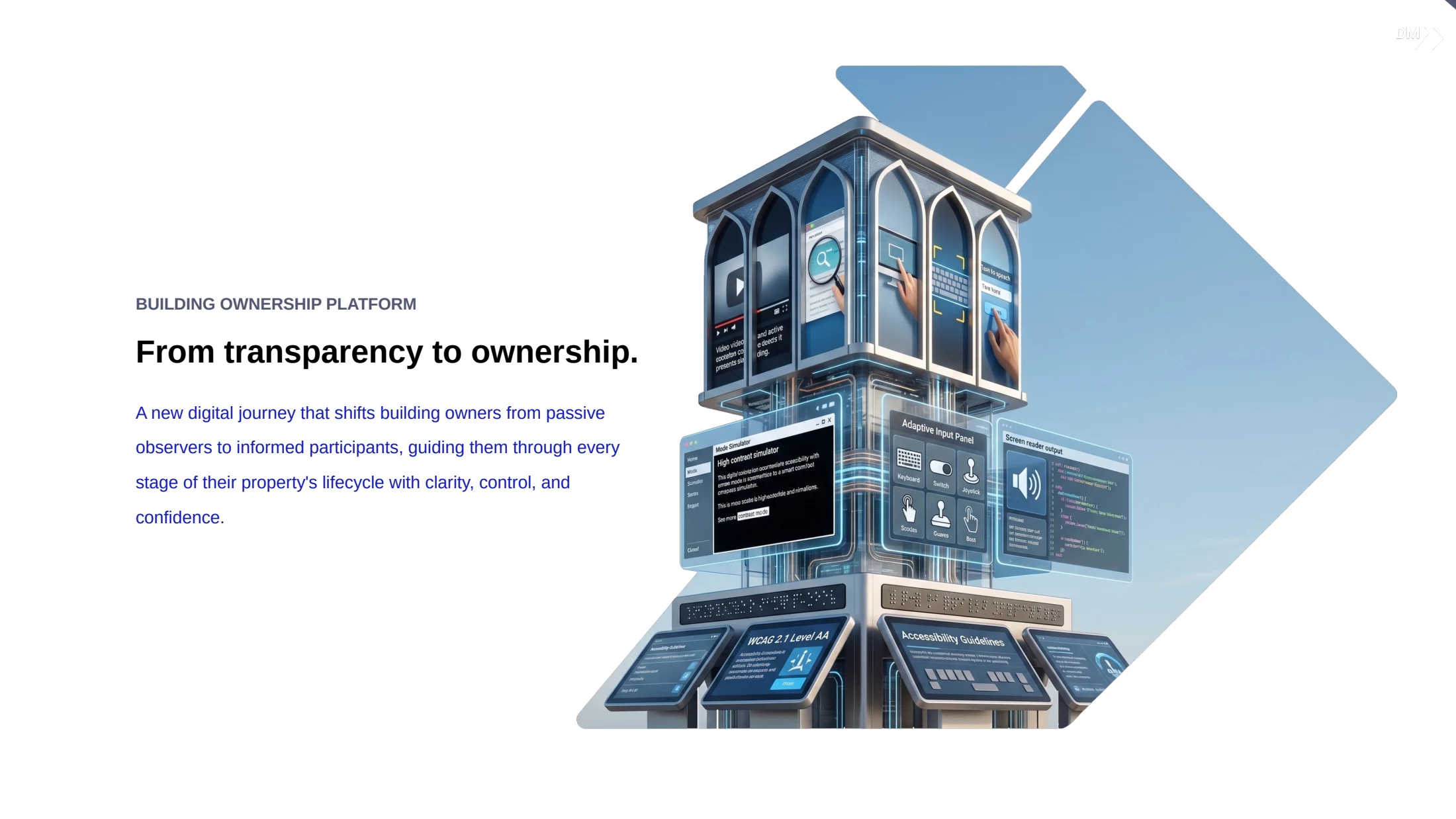
A product proposition for the person who owns the build
The new strategy reframes Build in Dubai around an owner who needs to understand and participate in the project. Consultants and contractors retain their professional responsibilities; the owner receives guidance matched to the stage of the build.
The product choice is to organise existing services around the owner’s lifecycle, with clear responsibilities, checks and access to expert help. It extends the earlier UX audit and behavioural work on the same project.
Define the behaviour before the intervention
The case-specific behavioural study focuses on understanding the personal project stage and taking the correct next action. Barriers include uncertainty about who is responsible, what comes next and why a submission was returned.
COM-B and EAST provide lenses for the proposed intervention. The goal is to reduce ambiguity and effort, rather than add an unrelated nudge to an unclear service.
Seven stages, with the right help at each stage
The proposed lifecycle covers design, permits, execution, completion and connection, use, modification and maintenance, and demolition.
Each stage becomes a bundle of explanation, checks, documents, tools and relevant experts. The bundle is the unit of customer understanding, while the underlying service systems remain the delivery foundation.
Personalisation with a defined service purpose
The proposal adapts guidance using owner context, what is being built and the current project stage. A journey composer asks relevant intake questions and maps the answers to applicable services and requirements.
Two supporting capabilities reuse consultation appointments and workshop delivery. Consultation questions can inform a reviewed knowledge library, while workshop demand helps prioritise topics.
AI-assisted contract review appears as a proposed owner tool. It needs reviewed regulatory sources, escalation to qualified advice and clear accountability before release.
A phased proposal with measurable learning
The source proposes a 90-day delivery sequence: establish the journey composer, arrange content into lifecycle bundles, then activate consultation and workshops. Delivery estimates require engineering and service-owner agreement.
A pilot should first check whether owners understand their stage and next action. Adoption, repeat questions, avoidable returns and dispute handling then need defined cohorts and baselines. The deck’s numerical targets remain expectations, not results.
Keep the study and the result separate
The final study is recorded as under study. Earlier experiment execution is not started and results are pending. The design proposal can be explained fully without inventing pilot success.
A meaningful test would compare owner understanding, next-action accuracy, avoidable returns and support dependence in a defined task/cohort. Those are proposed measurement priorities, not achieved results.
Outcomes and learning
Lifecycle stages in the proposed journey
Proposed support capabilities
A documented owner proposition, lifecycle structure and phased delivery proposal. The earlier audit and behavioural study support the problem framing; implementation and measured pilot outcomes remain future evidence.
About the evidence
- Actual Built in Dubai UX-audit page and case-specific behavioural study/intervention workbooks.
- Housing Fees UI links were not reused as Built in Dubai screens.
- Original project materials supplied in October 2026. Excerpts are integrated into the project story; targets and concepts are distinguished from released outcomes.